Up, Down, or Sideways: Choosing the Right Antenna Polarisation for Your Corner of Australia
If you've spent more than ten minutes in an Australian ham radio forum, you've probably seen the polarisation argument flare up at least once. Vertical. Horizontal. Mixed. Everyone's got an opinion, and half of them are quoting advice written for a Nebraska farmstead or a Welsh hillside. Neither of those places is much like Broken Hill or Wollongong, so let's talk about what actually matters for Australian operators.
The short answer — as always — is that it depends. But the longer answer is genuinely interesting, and getting it right can mean the difference between a solid contact and a wall of static.
Why Polarisation Actually Matters on VHF and UHF
At HF frequencies, the ionosphere scrambles polarisation so thoroughly that it barely matters which way your dipole is pointing. But on VHF and UHF — the bands where most Australian hams do their day-to-day operating — polarisation mismatch causes a real, measurable signal loss. We're talking somewhere in the range of 20 dB in ideal conditions, which is enormous. In practice, reflections and terrain scatter can soften that penalty, but you're still leaving signal on the table if your antenna and the station you're working are oriented differently.
So the question becomes: which way is everyone else pointing?
The Repeater Reality in Australian Cities
In metropolitan areas — Sydney, Melbourne, Brisbane, Perth — the answer is almost always vertical. The vast majority of repeaters in Australia are vertically polarised, and for good reason. Vertical antennas are omnidirectional in the horizontal plane, which makes them ideal for mobile operation. A car-mounted whip is vertical by default, and since a big chunk of urban ham activity involves mobiles checking into local repeaters, the whole ecosystem has evolved around vertical polarisation.
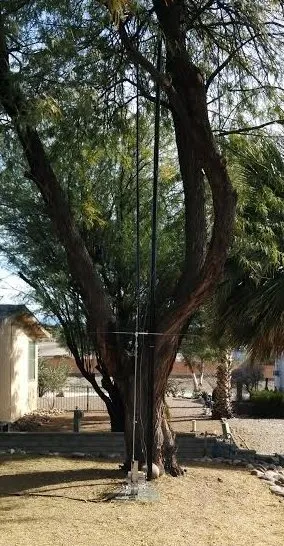
If you're setting up a home station in suburban Melbourne and your primary goal is to access the local repeater network and have a chat during the commute or on simplex with nearby operators, a vertical collinear is almost certainly your best option. Something like a Diamond X-50 or similar dual-band vertical will serve you well, and you won't be fighting the crowd.
Urban RF environments are also messy. Buildings, power lines, and other structures scatter signals in all directions, which partially masks polarisation mismatch anyway. In dense metro areas, getting height and clear line-of-sight often matters more than polarisation.
Coastal Operators: Ducting Changes Everything
Here's where things get more interesting. If you're based along the Queensland or NSW coast — or anywhere that experiences regular tropospheric ducting — horizontal polarisation becomes worth serious consideration for weak-signal and DX work.
Ducting events on the Australian east coast can be spectacular. Operators in Brisbane have worked stations in New Zealand on 2 metres during a good opening. When these events occur, the serious weak-signal crowd — those running Yagi arrays and chasing DX — almost universally use horizontal polarisation. It's the convention for EME, meteor scatter, and tropo DX globally, and Australian operators who want to play in that space need to match it.
If you're near the coast and you want to do both — work the local repeaters and chase the occasional tropo opening — a switchable or dual-feed antenna setup is worth considering. It's a bit more complex, but it's not out of reach for a reasonably handy operator.
Inland and Rural: Terrain Is Your Biggest Variable
Head inland — into the tablelands of NSW, the Darling Downs, or rural South Australia — and the calculus shifts again. Repeater density drops, mobile activity is lower, and many operators are running fixed stations talking to other fixed stations across long distances.
In these environments, terrain becomes the dominant factor. A vertical antenna on a ridge in the Snowy Mountains might give you fantastic coverage in multiple directions. The same antenna in a valley will be largely useless regardless of polarisation. Getting height — physically — often matters far more than the polarisation debate.
For rural operators doing regular WICEN or emergency communications work, vertical is still generally the practical choice because it matches the mobile units that will be in the field. But for point-to-point links between fixed stations on known bearings, a pair of horizontally polarised Yagis can deliver noticeably better performance, especially over longer paths where you can carefully optimise both ends of the link.
A Quick Decision Framework
Rather than a one-size-fits-all recommendation, here's a simple way to think through your own situation:
Primarily working local repeaters and mobiles? Go vertical. Full stop. Match the infrastructure and the other operators in your area.
Interested in weak-signal VHF/UHF contesting or DX? Go horizontal, and get a Yagi or a stack of them. That's the standard for a reason.
Running a fixed point-to-point link in a rural area? Horizontal Yagis at both ends, aimed at each other. The cross-polarisation isolation also helps reduce interference on the path.
Doing emergency communications or WICEN support? Vertical, because you need to match mobile units and you can't predict who will show up with what equipment.
Can't decide and want flexibility? A dual-band vertical for everyday use and a small horizontal Yagi for special occasions is a perfectly reasonable compromise.
Real Operators, Real Choices
A group of operators running a weekly VHF net out of the Hunter Valley settled this debate practically: they surveyed their regular participants and found that about 80% were using vertical antennas, mostly collinears on home stations or whips on mobiles. The net coordinator switched from a horizontal Yagi experiment back to a vertical collinear, and average signal reports improved across the board.
Contrast that with a small group of 2-metre DX enthusiasts in coastal Victoria who've built a dedicated weak-signal station with a horizontal Yagi stack. They have zero interest in the local repeater scene — they're chasing contacts across Bass Strait and beyond. Their horizontal setup is exactly right for what they're doing.
Neither group is wrong. They've just made sensible choices for their actual operating goals.
Don't Forget the Practical Stuff
Beyond the technical arguments, there are real-world constraints that often make the decision for you. Body corporate rules, rental agreements, and council regulations affect what you can physically mount on a property. A vertical collinear is generally less visually imposing than a pair of horizontal Yagis on a rotator, which can matter a great deal in suburban settings.
Wind loading is also worth thinking about in coastal and elevated areas. A horizontal Yagi presents significantly more surface area to the wind than a simple vertical, and Australian coastal weather can be brutal on antenna installations.
At the end of the day, the best antenna is the one you can actually mount, maintain, and operate effectively. Start with what fits your situation, get on air, and refine from there. The debate will still be running in the forums whenever you want to revisit it.