Cheap Coax, Costly Losses: A Field Test of Cable That Aussie Hams Actually Buy
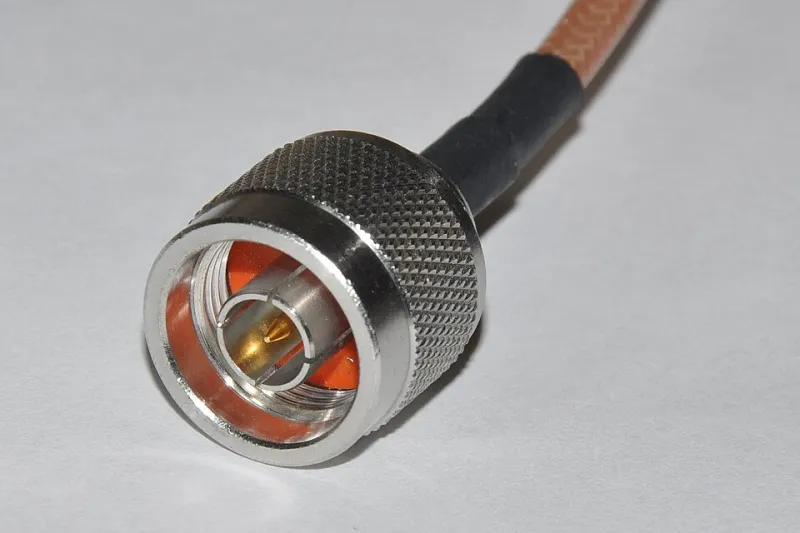
Photo: Joe Ravi, CC BY-SA 3.0, via Wikimedia Commons
Every station has a weak link, and for most of us it's the bit between the radio and the antenna. Coax is boring, it's expensive per metre, and it's the easiest thing in the whole hobby to cheap out on. So we dragged a pile of cable out of the shed, borrowed a NanoVNA, and spent a weekend measuring what people in VK are actually buying.
What loss actually costs you
Three decibels is half your power gone. Ten decibels is ninety per cent. On transmit that means a 100 W rig feeding a long run of thin cable might be delivering 25 W to the antenna on 70 cm — and you paid for the amplifier. On receive, loss is worse in a way, because it sits directly on top of your receiver's noise figure. A passive cable can never improve your signal-to-noise ratio; it can only make it worse.
The good news is that the arithmetic is simple and predictable. Once you know the loss per metre at your frequency, you can decide whether the cable or the antenna deserves the money.
How we tested
We used a NanoVNA in through-measurement mode, sweeping 1–500 MHz with the cable connected between the two ports and the instrument calibrated at the connector plane. Eight cable types, each measured at 50, 145 and 435 MHz, with results normalised to decibels per 10 metres so you can scale to your own run.
We also left three identical jumpers on a Sydney rooftop for a summer: one sealed with self-amalgamating tape, one with ordinary electrical tape, and one with nothing at all. More on that below.
Rough numbers for the cables people buy
Treat these as ballpark figures — your length, connector quality and how well the cable has been treated will all shift them — but the ranking holds.
| Cable | Cost (approx) | 50 MHz | 145 MHz | 435 MHz |
|---|---|---|---|---|
| RG-58 | $1–2/m | 1.0 dB | 1.5 dB | 3.2 dB |
| RG-8X / mini-8 | $2–3/m | 0.8 dB | 1.2 dB | 2.4 dB |
| RG-213 | $3–4/m | 0.6 dB | 0.9 dB | 1.8 dB |
| LMR-400 | $5–7/m | 0.35 dB | 0.5 dB | 1.0 dB |
| RG-6 (75 Ω) | $0.70/m | 0.9 dB | 1.4 dB | 3.5 dB |
| LDF4-50A heliax | $15+/m | 0.2 dB | 0.3 dB | 0.6 dB |
All figures are per 10 metres.
Where to save, where to spend
HF is forgiving. On 80 and 40 metres, a 20 m run of RG-58 costs you a fraction of a decibel. It's genuinely fine. Spend the money on a better antenna instead — nobody ever regretted a taller dipole.
Six and two metres are the middle ground. RG-213 handles a 15 m run comfortably. If your run is longer than 25 m, or you're chasing weak-signal work, step up to LMR-400.
Seventy centimetres is where cheap cable dies. A 30 m run of RG-58 on 435 MHz loses more than 9 dB — over ninety per cent of your power, and the same again in receive sensitivity. This is the one place where spending $200 on cable produces a bigger improvement than spending $200 anywhere else in the station.
Long runs and hardline. If you can get 30 m or more of LDF4 or similar second-hand from a commercial radio site, do it. Hardline is awkward to install and needs proper connectors, but on 2 m and 70 cm it's transformative.
Connectors: the other half of the story
PL-259 and SO-239 connectors are everywhere because they're cheap, plentiful and have been on every HF rig since the 1950s. They're not constant impedance and they're not weatherproof, but on HF and 6 m the difference is academic. Use them where they're convenient.
For VHF and UHF, N-type is the right answer. Better impedance match, threaded and sealed, and much less loss at 435 MHz. BNC belongs on test gear and short patch leads. What you should avoid is the adapter chain: every PL-to-N-to-SMA sandwich adds a little loss and a lot of failure points.
Solder or crimp properly. Crimp with the right tool is faster and more consistent; solder is fine if you're careful. Twist-on connectors belong in the bin, and any connector you haven't inspected in two years is a candidate for replacement.
Weatherproofing, tested by a Sydney summer
Australian conditions are brutal on cable in a way that European and American guides don't quite capture — UV, temperature swings, and storms that arrive sideways.
The roof test results were not subtle. The untaped jumper had water inside the connector within two months and visible corrosion on the braid by the end of summer. The electrical-tape version held on longer, but the adhesive went gooey and the tape lifted at the edges after a few heat cycles.
The self-amalgamating tape version was fine. The recipe: a layer of self-amalgamating tape wrapped under tension over the connector and back up the jacket, then a top layer of UV-resistant tape over that, and a drip loop so water runs off rather than into the fitting. Seal the top of the connector, not the bottom, and never fully bury the drain path. A dab of silicone grease on the threads costs nothing.
The false economies
- Copper-clad aluminium braid. Some marketplace cable uses CCA or aluminium foil instead of copper. It corrodes, it doesn't solder, and it's a false saving every time.
- "Military spec" listings with no data sheet. If there's no published loss figure at 100 MHz, it's not a specification, it's a slogan.
- 75-ohm TV cable pushed into 50-ohm service. RG-6 is astonishingly good value for receive-only SDR work, but running 100 W into a mismatched line with F-to-PL adapters is another matter.
- Buying the expensive cable and then using a 20 cm adapter chain. Fix the connectors before you upgrade the jacket.
- Not measuring. A NanoVNA costs less than a decent length of LMR-400. Measure a cable before you install it, then label both ends and write the loss figure on the tag.
A short buying checklist
Buy from a supplier who publishes loss figures. Buy the length you need, not the length that's on special. Terminate it properly, weatherproof it once, and check it after summer. And if you're running 70 cm down a long length of something thin, measure it before you blame the radio.