Sixty Bucks, Endless Signals: Building a Serious Scanner from a Cheap SDR Dongle
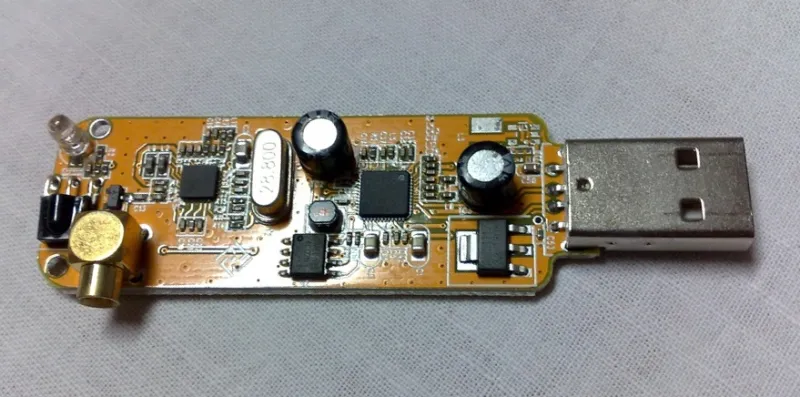
Photo: Dsimic, CC BY-SA 4.0, via Wikimedia Commons
There's a particular moment that hooks people: you plug a USB stick the size of a packet of matches into a laptop, string a bit of wire out the window, and suddenly there's a Qantas jet talking to Sydney Approach, a ferry on the Hawkesbury, the local UHF CB channel, and a satellite dribbling out a weather picture. Total outlay: about the price of two pizzas.
Software-defined radio has been cheap for a decade, but the dongles have quietly improved and the software has become genuinely friendly. If you've been putting it off because every tutorial seems to assume a Linux beard, this is your nudge.
First, the boring but important bit
Listening is fine. In Australia, receiving radio signals is not an offence in itself, and ACMA has no interest in what comes out of your speaker in the shed. What you must not do is use or divulge the contents of communications you weren't meant to receive — that's where people get themselves into trouble under the Telecommunications Act 1997 and related radiocommunications law. In practice: enjoy the listening, don't post a recording of someone's private conversation to a Facebook group, don't act on anything commercial you overhear, and don't transmit. The dongle can't transmit anyway. If you want to talk back, that's what a licence and a proper rig are for.
Choosing the right stick
Nearly all the cheap ones are the same chipset: an RTL2832U demodulator paired with an R820T2 tuner. They cover roughly 24 MHz to 1.7 GHz, which is most of what matters. The differences are in the details, and the details matter:
- Get one with a TCXO (temperature-compensated oscillator). Without it your frequency drifts as the dongle warms up, which is maddening on narrowband signals.
- SMA connector, metal case, shielded lead. The MCX-and-bare-board versions work, but they feel like they'll die in a toolbox.
- Budget $50–$80 delivered. Anything under $30 is usually missing the TCXO.
- Accept that HF is a compromise. Below 24 MHz you're relying on direct sampling or an upconverter, and performance is modest. For 80 m and 40 m done properly, buy a real receiver later.
Higher-end options such as Airspy, SDRplay and the Funcube are genuinely better, but they're not where you should start. Learn on the cheap one.
The antenna is doing the heavy lifting
The little whip in the box is a compromise that will disappoint you on everything except a strong local FM station. Two upgrades cover most of the hobby:
- A homebrew half-wave dipole cut for whatever you care about — fifteen minutes with wire, a balun and some tape, and it will outperform the whip by a country mile.
- A discone for wideband VHF/UHF. Ninety to a hundred and fifty dollars, covers 25 MHz to 1.3 GHz badly but usefully, and lets you sweep rather than hunt.
Height beats everything. A discone at 8 m on the roof of a suburban Sydney house will hear things a ground-level antenna simply won't. Use decent coax for the run — cheap RG-58 over 20 m at 400 MHz is a filter you never asked for.
Software that won't fight you
On Windows, SDR# is the classic and has plugins for everything. SDR++ is newer, cross-platform and far less fussy. On Linux or a Mac, GQRX or SDR++ again. You'll need to install a driver with Zadig once; every tutorial says the same thing because it's the only fiddly step.
Two settings will save you days of confusion: set the sample rate to 2.4 MS/s unless you have a reason not to, and turn automatic gain off. Set gain manually, starting low and nudging up until the noise floor just begins to rise. Chasing maximum gain is the single most common beginner mistake.
The overload problem
A dongle has a wide-open front end and no filtering worth the name. Put it on a rooftop antenna in any Australian capital and the FM broadcast band — 88 to 108 MHz, with transmitters in the tens of kilowatts — will hammer it. Symptoms: signals appearing where they shouldn't, a noise floor that lifts and falls, and images of commercial FM turning up at 300 MHz.
Fixes, in order of usefulness:
- An FM band-stop filter, about $30, in line before the dongle.
- Less gain, not more.
- A bandpass filter for the band you actually care about, especially 1090 MHz ADS-B and the airband.
- A 10 dB attenuator if you live near a transmitter site.
An overloaded dongle is worse than one fed with a wet bit of string, because you'll spend hours chasing ghosts that aren't there.
What's worth listening to from a VK shack
A rough sweep for suburban and regional operators:
- 118–137 MHz — airband. Sydney, Melbourne, Brisbane, Perth and most regional towers are busy and the audio is usually clear.
- 137 MHz — NOAA APT weather satellites, passing overhead a couple of times a day. Needs circular polarisation for a clean picture; a V-dipole will do to start.
- 144–148 MHz — the 2 m amateur band, including FM repeaters and FT8 on 144.174 if you pipe audio into WSJT-X.
- 156–162 MHz — marine VHF, busy anywhere near the coast.
- 476–477 MHz — UHF CB. Twenty years ago this was a wasteland; now it's the closest thing Australia has to a national unlicensed network.
- 1090 MHz — ADS-B. With dump1090 and a $20 filter you can track aircraft several hundred kilometres out.
- 433.92 MHz — garage doors, weather stations, power meters. rtl_433 decodes a surprising number of them.
Decoding beyond voice
The satisfying part of SDR isn't listening, it's decoding. rtl_433 turns your dongle into a sensor monitor. dump1090 plus a web front-end gives you a local flight tracker. multimon-ng will read POCSAG paging traffic that's still in the air in some places — though think hard about whether you need to, given the privacy rules above. DSD+ handles a lot of the digital voice modes and is a rabbit hole that has eaten entire weekends.
There's also real value in leaving it running: a dongle parked on 50.313 MHz will tell you when six metres opens while you're at work, and one parked on 137 MHz will quietly collect satellite passes for you to look at over dinner.
The sixty-dollar verdict
A cheap dongle won't replace a proper receiver, and it won't hear weak signals a decent rig would. But as a listening post — something that sits on the shelf, tells you when the band's open, decodes aircraft and sensors, and teaches you how radio actually behaves — it's the best value in the hobby. Buy one, build a dipole, and see what's out there.